
The Gray Wave: Seniors Living on Four Wheels
Seniors are living in RV parks to avoid unaffordable rent.

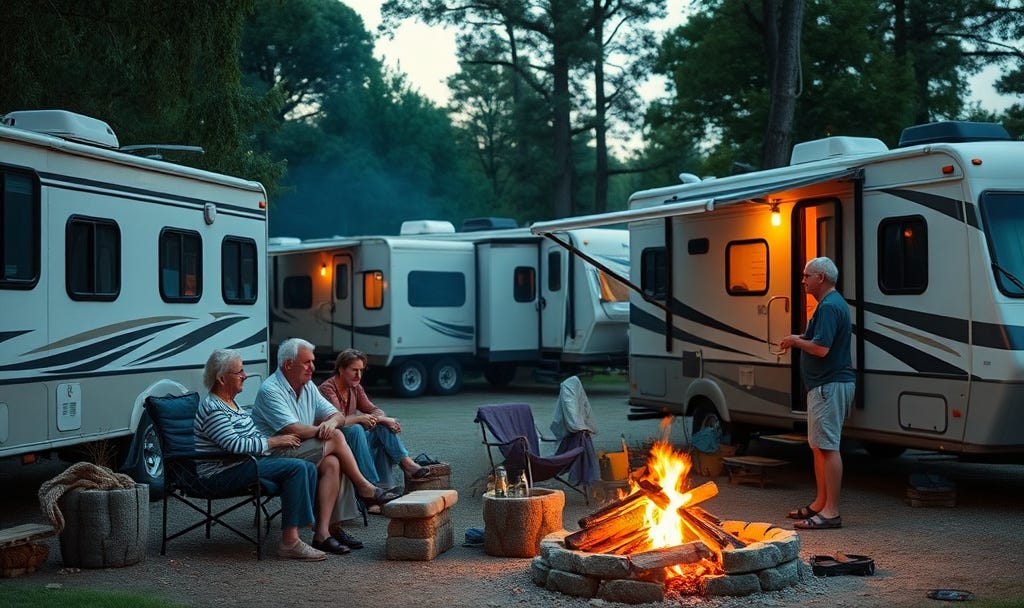
As I sit here on a warm March morning in S. Tucson, I’m looking out over a sea of white fiberglass and aluminum. The RV park is packed. but what hits me isn’t just the number of campervans and RVs; it’s the silver hair behind the steering wheel.
I often write about the freedom of the open road in this newsletter, but lately, the conversations around the campfire pits have taken a heavier turn. For a growing number of us in our 60s, 70s, this lifestyle isn’t just a wanderlust-fueled retirement dream. It’s an economic lifeboat.
Economic Data From The Past Year
Let’s look at the hard numbers, because the economic data from the past year paints a stark picture of why the “Gray Wave” is flooding into RV parks.
According to recent data from “Hud Housing”, the number of senior households considered “severely cost-burdened”__meaning they spend more than half their income on housing, has nearly doubled over the past two decades to an astonishing 11.7 million people. The Harvard Joint Center for Housing Studies confirms this grim reality, noting that approximately one-third of older adult households are now cost-burdened.
When you are forced on a fixed income, giving up 50% or more of your Social Security check just to keep a roof over your head leaves practically nothing for food, gas, or medicine. And speaking of healthcare, a recent report highlighted that fewer than 15% of single adults aged 75 or older can afford the combined costs of traditional housing and long-term care. The math simply no longer works for the average American retiree.
People Are Forced into the Fast Lane
So, what happens when traditional rent becomes a mathematical impossibility? You downsize drastically.
Out here in the real world in 2026, we are seeing the direct result of this inflation fatigue. A recent 2026 housing documentary highlighted that in many long-term RV parks across the country, 40%-60% of permanent residents are now over the age of 65.
We aren’t just taking week-end trips anymore.
The DYRT’s recent camping report revealed that nearly 33% of all campers are 55 and older, and a staggering 61% of campers in that age bracket list an RV or camper as their primary home.
They traded skyrocketing property taxes and relentless rent hikes for lot fees and gas mileage.
For many seniors, the open road wasn’t just a choice; it was the only affordable address left in America.
Thanks for reading!
Kindly,
Carol
Thank you for reporting this unfortunate news. 😢
If I didn't live in a Canadian city where it's winter for 7-8 months of the year, I would definitely opt for this lifestyle. I'm in my 50s and have to move sometime this year, and it is SOUL CRUSHING to know that I'll have to spend $1800-2000 on a 1 bdrm apartment 😞 And there are no alternatives. I currently share a home and I'm still paying $1750. I would love to say f**k it and be able to go mobile!