
Van Life for Teachers, Writers, and Remote Workers: Is it Really Possible?
The rent is too high, the salaries are too low, and some of us are done pretending otherwise.

I’m a 75-year-old public school teacher sitting in Tucson, Arizona, and I’m seriously planning to live full-time in a van. Not because I have to, but because it makes more sense than anything else, I’ve tried.

If you’ve been reading my newsletter for a while, you know I’ve been on this journey for a bit. And the more I research, the more I realize van life isn’t just for young minimalists with Instagram accounts and trust funds. It’s quietly becoming one of the most practical solutions for people like me — teachers, writers, and remote workers who need a home base that moves with them.
Why This Lifestyle Makes Sense for Us?
Think about what teachers, writers, and remote workers all have in common: we work from laptops. We keep odd hours. We don’t need a physical office — we need Wi-Fi, a quiet space, and enough electricity to keep our devices running.
A converted van or minivan can give you all three. A modest solar setup — something in the 400-watt range paired with a good power station — handles a laptop, phone charging, a small fan, and lighting without breaking a sweat. I’ve been deep in the research on Bluetti and Renogy systems, and the technology has gotten genuinely affordable in the last few years.
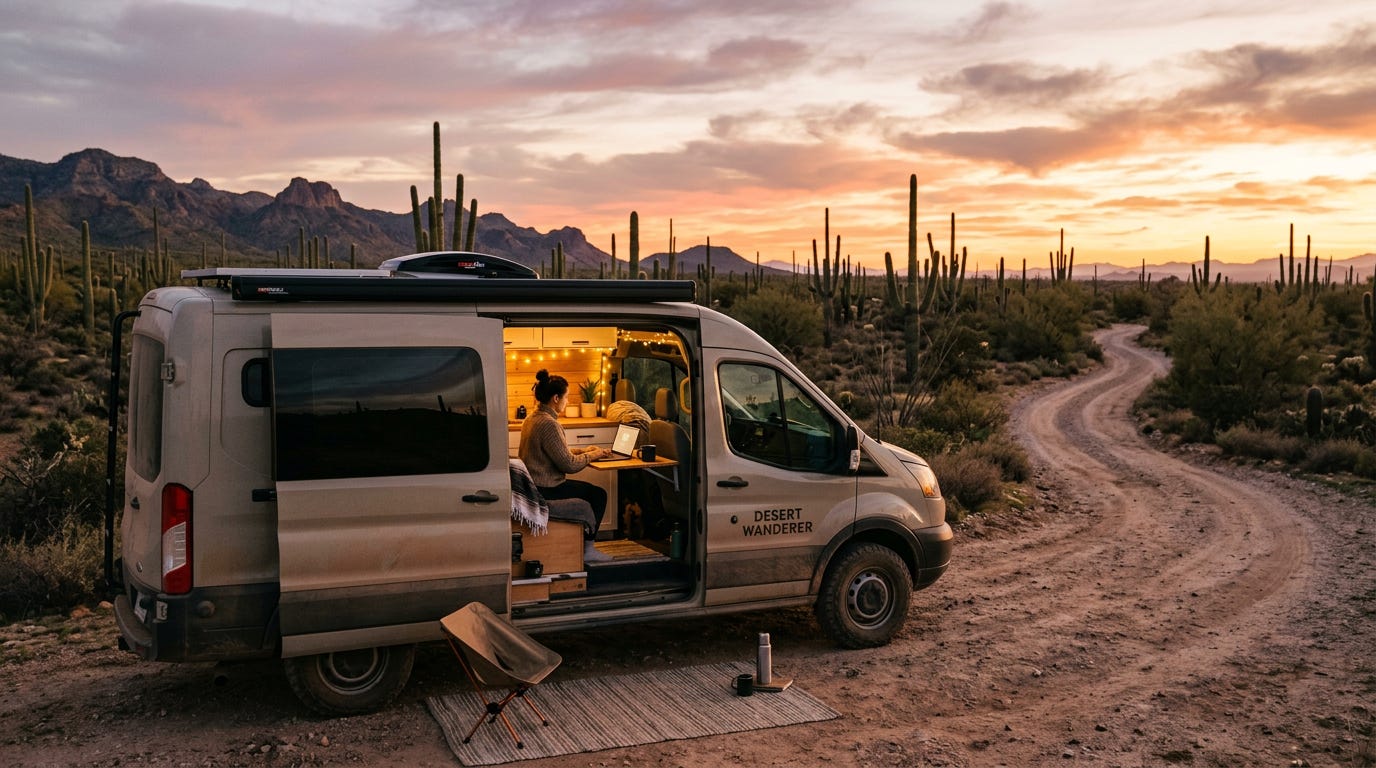
For teachers like me doing virtual instruction, the ability to park in a quiet spot and log into Canvas from anywhere is a significant change. Imagine finishing your school day, closing the laptop, and being parked at a BLM campsite in the Arizona desert by evening. That’s not a fantasy. That’s a Tuesday.
What about the money?
Here’s the part nobody wants to talk about plainly: housing costs are brutal right now. Rent in most cities consumes half of a teacher’s salary. Writers rarely earn a stable income, especially early on. Remote workers are often trading job security for flexibility, which is wonderful until the lease renews.
Van life slashes your biggest monthly expense to near zero. No rent. No mortgage. Campsite fees on BLM land? Free. A weekly spot at an RV park when you want a shower and laundry? Roughly $150–$250. That’s it. The math is almost embarrassing once you run it.
I’m building my Substack while I plan this transition — because I believe this story needs to be told by someone actually living it, not just theorizing from a comfortable apartment.
You don’t have to be young or fearless
What I want you to take away from this is simple: van life is not a young person’s game anymore. It’s a smart person’s option. Whether you’re a teacher burned out on paying rent in an expensive city, a writer who needs flexibility to follow your work, or a remote worker who wants to stop feeding a landlord every month — the road is open to you.
I’m figuring it out one step at a time, and I’m taking you with me. That’s what this newsletter is for.
Drop a comment and tell me — have you ever seriously considered van life? What’s the one thing holding you back?
The house you can’t afford and the van that makes sense
Let me tell you something that nobody in a school district meeting will say out loud: teachers can no longer afford to live in the communities where they teach.
That’s not an opinion. That’s a fact backed by hard numbers. Between 2019 and 2025, housing costs in this country rose by 47 to 51 percent. Teacher salaries? They grew about 24 percent. In some cities, a beginning teacher hands over more than 45 cents of every dollar they earn straight to a landlord — before groceries, before gas, before a single bill gets paid. This isn’t a personal finance problem. This is a systemic failure, and it is pushing talented, dedicated people out of the profession entirely.
I’ve been in education most of my life. And I am telling you — van life is starting to look less like a quirky lifestyle choice and more like a rational response to a broken system.
The math nobody wants to do
In St. Paul, Minnesota, teacher salaries went up 20 percent between 2019 and 2025. Rents went up 51 percent in the same period. Read that again. Rents went up more than twice as fast as pay. In Anoka-Hennepin, same story — 21 percent salary growth, 51 percent rent increase. And these aren’t coastal cities with Manhattan price tags. These are ordinary American towns where ordinary teachers are quietly drowning.
Writers and remote workers aren’t in much better shape. The average home price in America now sits above $416,000. A down payment alone — even a modest one — can run $20,000 to $80,000. For a freelance writer or a remote worker on a contract basis, that number might as well be written in a foreign language.
Meanwhile, van life communities are actually growing in 2026 — not because people are chasing adventure, but because they are doing the math and choosing sanity over debt.
This is a housing crisis disguised as a lifestyle trend
Here’s what bothers me most: when people see someone living in a van, the first instinct is pity. Or judgment. They must have made bad choices. They must be irresponsible.
What if they just did the math?
What if the schoolteacher in the converted Chrysler Pacifica parked at the BLM campsite outside Tucson isn’t a cautionary tale — but a pioneer? What if she figured out something the rest of us are still too scared to admit? She cut her largest monthly expense down to nearly zero. She kept her job. She kept her dignity. She kept her savings.
I’m not romanticizing poverty. I’ve written about homelessness right here in this newsletter for four years now, and I take that crisis seriously. There is a profound difference between someone forced onto the streets with no options and someone making a deliberate, strategic choice to opt out of an extractive housing market. We have to hold both truths at once.
What teachers, writers, and remote workers can actually do
The beauty of van life for people in our professions is that we already work from screens. A teacher doing virtual instruction needs Wi-Fi and a quiet space — not a two-bedroom apartment at $1,800 a month. A writer needs a laptop, good light, and solitude. A remote worker needs a reliable power source and an internet connection.
A properly set up van gives you all of that. Four hundred watts of solar on the roof. A solid lithium battery system. A hotspot. A comfortable workspace. Total monthly overhead that can run under $300 if you know what you’re doing.
That is nothing. For a lot of people reading this right now, that number is the difference between barely surviving and actually building something.
The bigger picture
I believe van life, and other alternative housing choices like tiny homes and co-housing, are the beginning of something larger. People are quietly opting out of a housing market that has decided their labor is worth less than a landlord’s investment portfolio. Teachers, writers, remote workers — we built this country’s intellectual and creative backbone. We deserve better than being priced out of it.
Until the system catches up, some of us are going to keep driving toward the sunrise.
And I’ll be right here, writing about every mile of it.
If this hit home, share it with a teacher, a writer, or anyone you know who’s quietly exhausted by the cost of just having a roof over their head. And leave a comment — I read every one.
Thanks for reading!
Kindly,
Carol
Note 2 — Wednesday, April 2
(Personal and provocative)
Note 3 — Thursday, April 3
(Question to drive comments)
Note 4 — Saturday, April 5
(Housing advocacy angle — strong opinion)
Note 5 — Monday, April 7
(Keeps momentum going into the following week)
S
Your Copy-Paste Plan
Easier — Use the Google Doc on Your Phone
Ip
generated-image.pngGenerated Image
Prepared using Claude Sonnet 4.6
Trust me, I've thought about it way more than I should have. Both for the practicality AND the adventure of it.
What would bother me (as a retired but still nerdy accountant) is ongoing expenses - insurance, repairs, fuel - for the van plus the cost of ultimately replacing it when repairs are no longer economical. Year by year you would either need to take into account depreciation on the van or - more use from a practical point of view - save each month towards the next van. I think this is where the van living plan can fall over.