
The Long Nights in Anchorage, Alaska
The sound of a zipper freezing shut is distinct. It's not a snag or a catch; it is a weld.

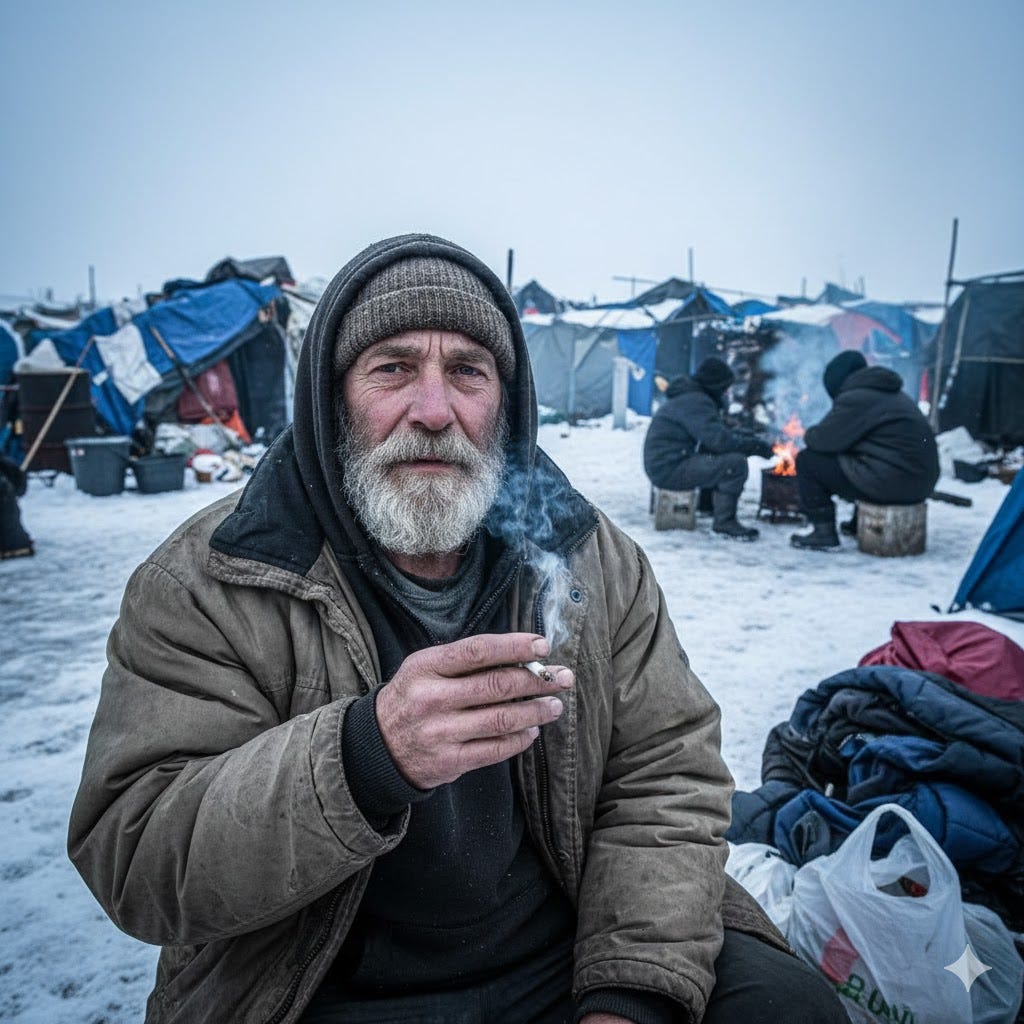
Sixty-four-year-old Elias Jackson lay in his bed in the crushing dark at 10 A.M.. He was struggling to breathe as he rolled out of his sleeping bag, his arthritis burned in his right hand while he fought with the metal zipper on his blue nylon tent, so he could rise and get outside.
Anchorage inhaled him
The outside air didn’t just smell of pine and snow; it reeked of feces, urine, diesel exhaust and the stale smoky scent of a wood fire that had died hours ago. He stood up in a patch of woods near the railroad tracks, brushing frost from his beard, while relieving himself of urine.
He patted his chest pocket. The debit card was still there. Thank God! It was the third of the month. The Deposit! Yeah!
Six hundred dollars!
It was a fortune to Elias, and yet it was nothing. It meant the difference between life and death, but never enough for a life.
The Hardware Store
The hardware store was bright. The fluorescent lights hummed a high-pitched tune that made Elisa’s head throb. He stood in the camping aisle, wearing a Goodwill jacket that was two sizes too big, staring at the green canisters of propane.
He did the math. He always did the math. It was a loop that ran in his head while he tried to sleep.
$600 - $80 for the storage unit on Fireweed Lane. It was a 5x5 metal box, unheated, but it held the photo album of a daughter who moved to Seattle ten years ago and stopped calling two years after that. Even though he couldn’t burn the photos for heat, or eat them. But if he stopped paying, they went to the landfill, and Elias ceased to exist. $520 left, minus $40 for the prepaid phone, his panic button. His connection to a world that didn’t want him. Now $480 left.
He picked up a $15 two-pack of propane. He needed 10 of these to guarantee he wouldn’t wake up hypothermic. $150 gone. $330 left over. That was it. Three hundred and thirty dollars. For thirty days. Eleven dollars a day.
Elias looked at the hand warmers next to the propane. A box of ten instant hand warmers for his stiff, clawed hands. He reached for them, his fingers trembling slightly. Then he looked at the price tag $8.99.
He put the hand warmers back.
“Just the gas,” he moaned to himself.
At the register, a tourist in a pristine North Face parka was buying a hatchet, a high-end cooler, and a bag of jerky. He laughed at something the cashier said, slapping a credit card down on the counter without looking at the total. Elias stood behind him, clutching his propane against his chest, counting the quarters in his pocket to make sure he had enough for the bus, sweating in his heavy coat, but feeling colder than he ever had outside.
Elias spent his days moving because stopping meant freezing. He walked the icy sidewalks of Midtown while the wind off Cook Inlet went slicing through his layers. While watching cars idle at red lights, exhaust puffing white smoke, drivers adjusting their thermostats. He remembered the smell of a truck cab heating up—dust and old coffee. He remembered being the man inside the truck.
On Tuesday, he sought sanctuary in the Loussac Library. The heat hit him like a physical blow, softening the ice in his beard to dripping water. He went to the bathroom to wash his face. In the mirror, a stranger stared back—eyes red-rimmed, skin windburned to the color of raw beef, gray hair matted.
He washed his hands in the hot water until they turned bright red, just to feel the sensation of burning without pain. A security guard walked in, eyes flicking to Elias, then to the paper towels. Elias dried his hands quickly, head down, shrinking into his shoulders. He left before asked to leave.
The Big Crisis Arrived on the 20th
Elias returned to camp to find his tent collapsed under the weight of fresh snow. He dug it out with frantic, clumsy hands, but the damage was done. His sleeping bag was soaked.
Elias sat on a plastic bucket, staring at the sudden mess. There was $14 left on the card. He couldn’t buy a new sleeping bag, or go to a laundromat to dry this one. The bus fare alone would bankrupt him.
Dinner was a can of beans, eaten cold. To heat them would waste propane. Elias ate mechanically, the beans tasting like tin and despair. He needed ibuprofen for his right hand and knees, but the bottle was empty, and the choice had been beans or pills. He chose calories.
That night, the temperature plummeted. It hit -15 degrees.
Elias froze. He shook the canister. Empty. No, he squealed. “No, no, no”.
He fumbled for the spare. His fingers were stiff, unresponsive blocks of wood while dropping the empty canister. He grabbed the new one and tried to thread it onto the heater head, but the threads wouldn’t catch. His hands were shaking too violently.
The cold rushed in instantly, claiming the space. Elias knew the signs. If he fell asleep now, he wouldn’t wake up. The “umbilical” sleep. Warm and drifting and final.
He had to move.
Elias scrambled out of the tent, leaving the soaked sleeping bag, the heavy tarp and photos in the storage unit that were never to be seen again. He stumbled up the embankment toward the road.
He collapsed on a snowbank near the intersection of 36th and C Street. His lungs burned while looking up..
The Sky Had Torn Open
The Aurora Burealis was dancing. Great ribbons of neon green and violent slashed across the darkness, shimmering and undulating like living curtains. It was the most beautiful thing he had ever seen.
Elias began to cry.
He didn’t cry because he was sad. He cried because it was so cruel. The world was capable of such breathtaking majesty, such impossible beauty, and it was killing him. It didn’t care. The lights danced over the mountains, over the warm houses with their fireplaces, over him dying in a snowbank.
“Please,” he whispered to the lights. “Just let it be warm.”
“Hey, old timer. Hey”
The voice was harsh, dragging him back from the edge.
Elias blinked. Bright artificial light flooded his vision. while slumping against the brick wall of the Holiday station. The clerk, a kid with eyebrow piercings and a kind face named Marcus, was shaking his shoulder.
“You can’t sleep here, man. You’ll die.”
Elias tried to speak, but his jaw was locked.
Marcus sighed, looked around to check for his manager, and then hauled Elias up. “Come inside. Just for a bit. Vestibule only.
He sat Elias down between the inner and outer doors and shoved a cup of coffee into his hands. “it’s on the house. Don’t tell anyone.
The cup was hot. Painfully hot. Elias held it with both hands, letting the heat seep into his palms, traveling up his wrists, thawing the blood in his veins. He took a sip. It was bitter and burnt and tasted old and warmed over.
He sat there for an hour, watching the steam rise from the cup until the sky turned a bruised purple.
Marcus knocked on the glass. “Shift change, Elias. You gotta go.”
Elias nodded. He stood up, his joints screaming, and pushed out into the morning air.
The sun was breaching the Chugach Mountains. It painted the snow in shades of soft pink and gold. It looked warm and inviting.
But as Elias zipped his jacket and turned back toward the woods, toward the frozen tent and the long wait for the next month, he knew the truth. Th sun was just light. It offered no heat. He had survived the night, but the calendar had only turned one page.
He had ten days until his check came on his card.
He began to move, walk, and pray, “Lord help me make it; because I can’t do this on my own anymore.” All Elias wanted to do was just go someplace warm and lie down.
Thanks for reading!
Kindly,
Carol
Excellent work Carol. You have captured the essence of living bare bones subsistence.