
Building a Substack Newsletter From the Road
Finding purpose, consistency, and income as a solo van lifer

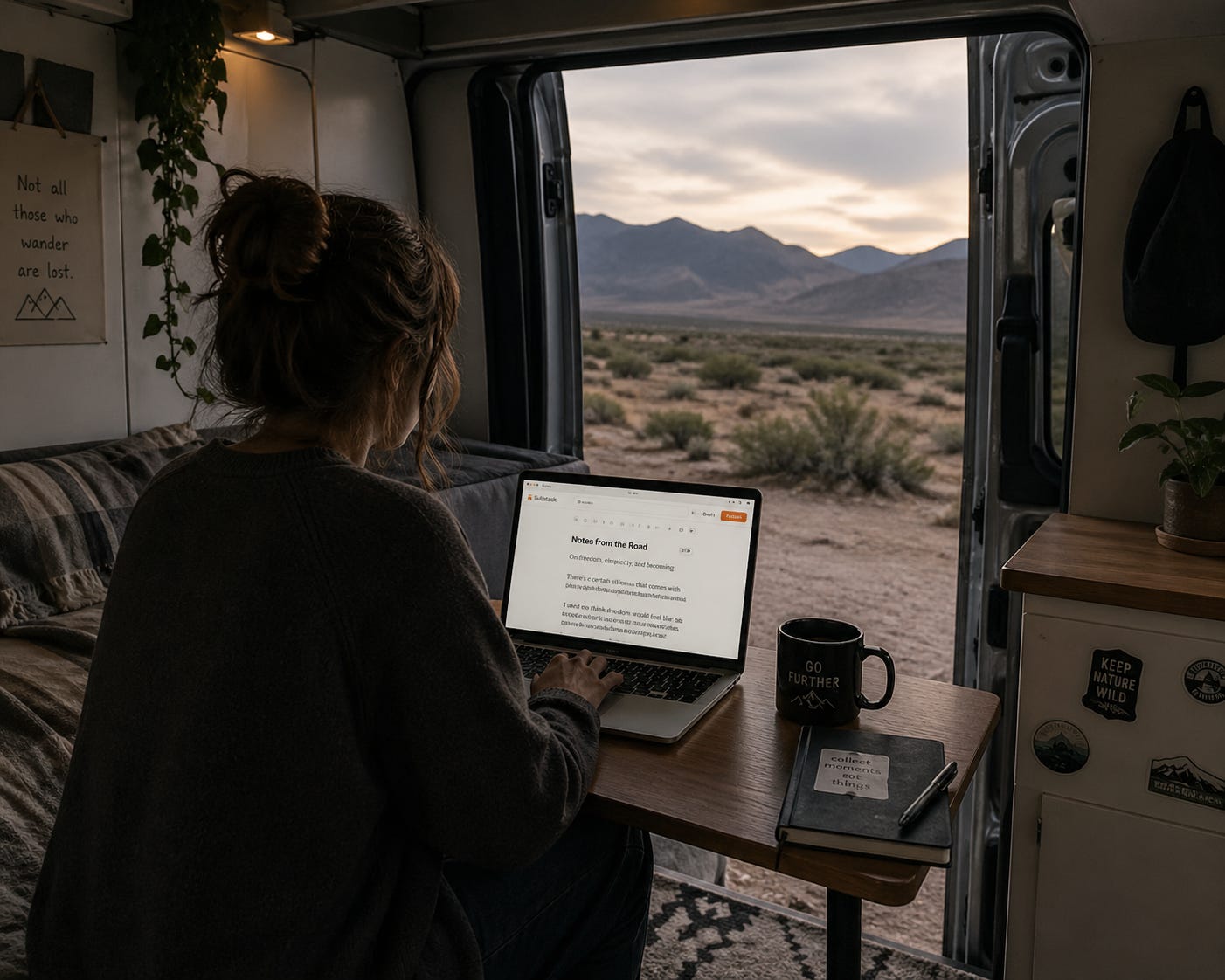
I’ve been writing on Substack for a little over five years now. And if I’m being honest, it’s taken me a long time to truly understand consistency.
I’m still learning it. I’m still searching for my rhythm—like a heartbeat finding its pace.
Because I’m an early riser, I’ve learned that my best writing happens in the morning, when the world is still quiet and full of possibility. I sit down before noon, when my mind is clear and uncluttered, and I can slip into that sacred flow where the words come not from effort, but from somewhere deeper. Most days, I work Monday through Friday and leave the weekends open to live life on my own terms—to remember what it feels like to simply be.
Traveling as a solo van lifer has given me something I didn’t have before:
Time.
Time to think. Time to write. Time to reflect on the life I’ve lived—the roads I’ve traveled, the mistakes I’ve made, the moments of grace I almost missed.
Today, I have over 1,900 subscribers—real people who signed up to hear my story. That’s something I don’t take lightly. Behind every number is a person with their own dreams, their own struggles, their own reasons for showing up. And with that comes responsibility—the kind that sits warm and heavy in your chest, reminding you that your words matter to someone, somewhere.
To stay consistent, I use a three-month content calendar to plan ahead. I publish two posts each week and write three short notes daily—morning, noon, and evening. Those notes are like breadcrumbs scattered throughout the day, helping new readers find their way to me when they need a moment of connection.
I also use scheduling tools to plan my content in advance. Because life happens. Life always happens. We don’t always have control over our time, our energy, or even our own hearts. But having things scheduled—knowing the work will go out even on the days I can barely get out of bed—helps me stay consistent, even when everything else feels uncertain.
My Daily Routine on the Road
Van life may feel lonely to some people, but for me, it isn’t. I’ve created structure in my day, and that structure has become a kind of home—the only home I can carry with me, no matter where I park.
My typical day looks like this:
Wake up at 5:00 a.m. — The world is still sleeping, and I have it all to myself
Stretch, check the weather, and take my medication — Small rituals that anchor me
Make coffee and write in my journal — Honest words no one else will read
Cook and eat breakfast — Something warm, something simple
Create a to-do list — Just a few things. Nothing impossible.
Within about 30 minutes, I begin writing my Substack posts. The words come easier in the morning, when I haven’t yet spent my energy on the noise of the day. Once I’ve finished writing and scheduling, I handle comments, engagement, and planning ahead—tending to the relationships that have grown from this work.
By noon, my Substack work is done.
The rest of the day is slower, gentler:
Lunch and a short walk — Moving my body, clearing my head
Rest, sometimes a short nap — No guilt, no apology
A few open hours — To do whatever comes my way, or nothing at all
Later in the day, I spend one to two hours working on my novel—a story about a homeless man named Smitty, a man who exists somewhere between invisible and unforgettable. I write at least an hour each day, then step away and rest. Some stories need space to breathe before they can be finished.
My bedtime is usually between 8:00 and 9:00 p.m. I try to keep that consistent, because I’ve learned the hard way that good rest matters more now than ever. Sleep is the foundation everything else is built on.
Why I Keep Going
Building a Substack newsletter while living on the road has given me something deeper than income, something more lasting than recognition.
It has given me purpose.
Between writing my newsletter and working on my novel, I feel a sense of direction—a reason to wake up at 5:00 a.m. and start again, a reason to keep moving forward, one small day at a time.
And on the hardest days—the ones where loneliness creeps in like fog, where doubt whispers that none of this matters—I remember those 1,900 people. I remember that somewhere, someone is reading my words over their morning coffee. Someone is finding a piece of themselves in my story.
And that is enough.
That has always been enough.
So comfortable and inspiring that I read it twice.
Hi Carol. I ordered your book some days ago and thought it downloaded but I can’t find it anywhere. Could you check please, and give me any pointers re: downloading because I’d like to order more. Thanks. Also I don’t see any way to contact you except by leaving a comment here.